Recently, while watching Upload on Prime Video- I found myself returning to a question that has quietly existed at the center of my artistic practice for years: what happens when memory no longer belongs entirely to the body?
The series imagines a future in which human consciousness can be digitally preserved after death, transferred into artificial environments designed to simulate continuity, intimacy, and even eternity. Beneath its futuristic aesthetics lies something profoundly unsettling: the possibility that memory itself may become detached from lived physical existence.
Today, this no longer feels entirely speculative.
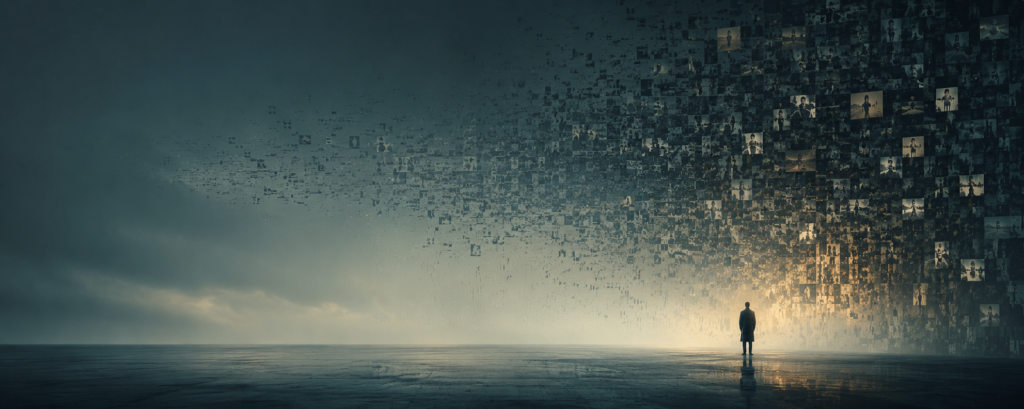
We already externalize memory constantly. Our photographs, conversations, emotions, routines, and fragments of identity are distributed across servers, archives, algorithms, and platforms. Social media timelines remember for us. Artificial intelligence reconstructs patterns of thought. Digital systems preserve traces of our existence long after moments themselves have disappeared.
In this context, memory slowly shifts from something organic and fragile into something editable, reproducible, and increasingly synthetic.
This reflection also reminds me of Do Androids Dream of Electric Sheep? by Philip K. Dick, a novel that explored long before our present moment the fragile boundary between authentic emotional experience and artificial consciousness. What makes the book so unsettling is not the existence of synthetic beings themselves, but the possibility that memory, empathy, and identity may eventually become indistinguishable from simulation. In many ways, contemporary technology no longer makes this question feel fictional.
This idea strongly resonates with the reason I paint hybrid bodies in an increasingly artificial world.
Over the last few years, my artistic practice has developed around a question that becomes more urgent with each technological acceleration: what does it still mean to be human in a reality shaped by algorithms, artificial intelligence, hyperconnectivity, and synthetic images?
My paintings do not attempt to provide definitive answers. Instead, they function as spaces of tension between the organic and the artificial, between body and system, between memory and simulation. The figures I construct often exist in states of transition — neither fully human nor entirely mechanical. They inhabit fragile intermediary territories where identity becomes fluid, unstable, and negotiable.
I continue to work in oil on canvas precisely because I am interested in the contrast between traditional painting techniques and deeply contemporary anxieties. There is something almost paradoxical in using a medium associated with the old masters to represent fears connected to digitalization, optimization, artificial consciousness, and technological control. The painting process itself becomes slow, meditative, almost opposed to the accelerated rhythm of online image consumption.
What interests me is not the body as anatomy, but the body as a psychological and cultural territory.
In works such as Identity Disorder, Loading Perfection, or Relinquishment, the body becomes a site upon which external pressures act continuously: standardization, performance, optimization, validation, and the illusion of a digitally constructed perfect identity. The implants, cables, and biomechanical structures within my work are not decorative science-fiction elements, but symbols of the way technology increasingly restructures human self-perception.
I often think about painting as a form of archaeology of the present.
Contemporary existence is gradually migrating toward virtual space: memories stored digitally, relationships mediated through screens, identities performed for social platforms, and an increasing desire to archive ourselves against disappearance. In this landscape, the body becomes simultaneously vulnerable and augmented.
This is perhaps why the idea of synthetic memory feels so compelling to me. Not because technology will necessarily destroy humanity, but because it may slowly replace lived experience with simulated continuity — versions of ourselves preserved as data, capable of surviving beyond the instability of biological memory.
At what point does remembrance stop being emotional experience and become merely information performing intimacy?
I am deeply influenced by artists who explored the body as a site of transformation and alienation. Francis Bacon distorted the human figure to express psychological fragility and existential anxiety. H. R. Giger created some of the most iconic biomechanical visions in contemporary visual culture, where flesh and machine become inseparable. Zdzisław Beksiński constructed posthuman universes marked by decay, metaphysical memory, and silence. In different ways, Jenny Saville and Patricia Piccinini also investigate the body as a mutable and emotionally charged structure shaped by technology, biology, and perception.
Theoretical ideas surrounding posthumanism equally inform my practice. Thinkers such as Donna Haraway or Jean Baudrillard influenced the way I perceive contemporary imagery: as simulation, extension, and mechanism of control.
I do not seek to condemn technology, nor to glorify it. My relationship with it remains fundamentally ambivalent. Technology produces alienation, but also new forms of memory, connection, preservation, and possibility. That ambiguity is precisely what fascinates me.
Within my paintings, beauty coexists with discomfort, and sometimes the artificial becomes more emotionally sensitive than the human itself.
Ultimately, my artistic practice attempts to document the moment humanity begins redefining itself — not in some distant future, but now.